
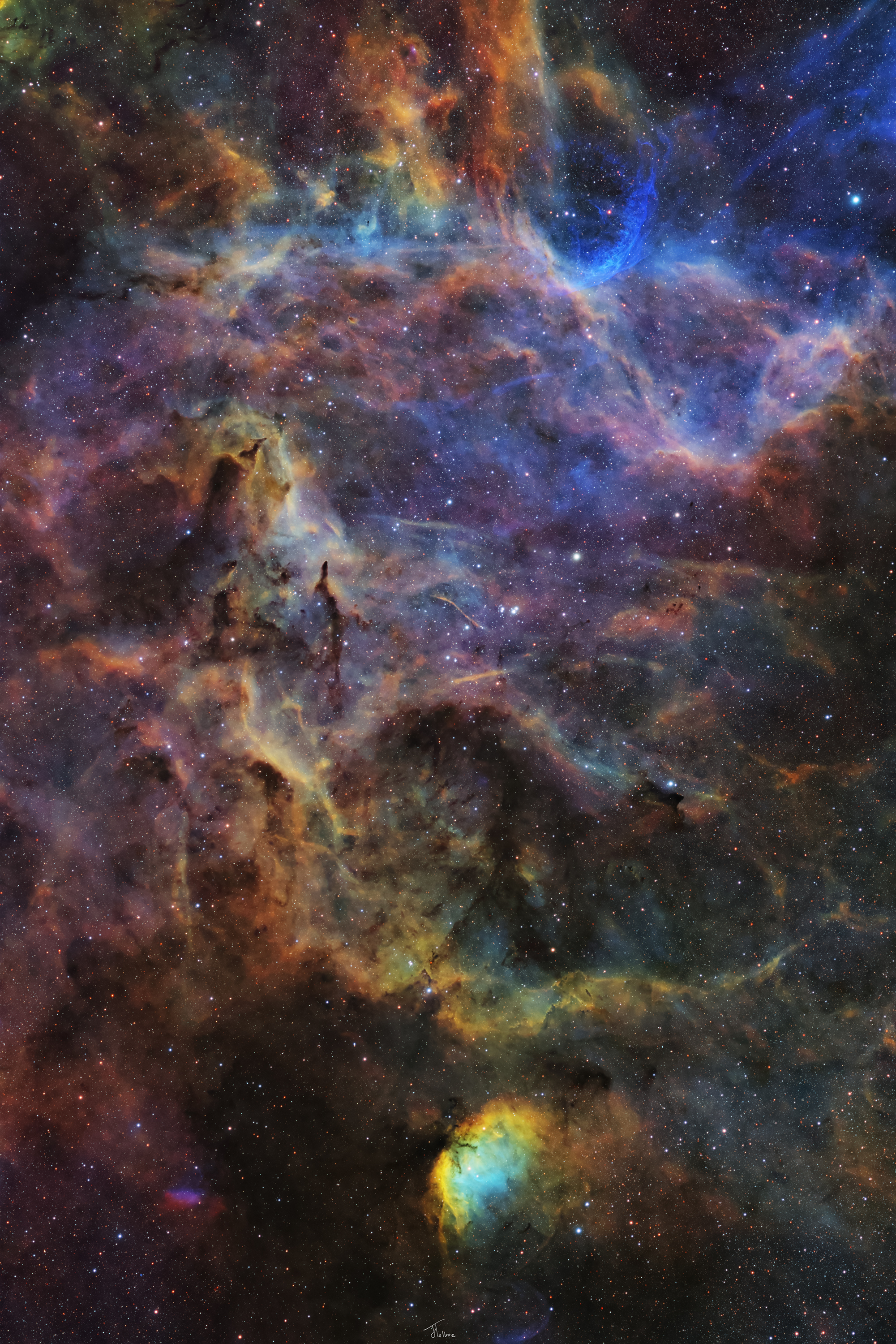
While to our eyes this area would appear primarily pink and red, one thing narrowband palettes do very well is provide excellent visual separation of the gas structures and different emission lines, which is especially true here. At the top right of the image, surrounded by the blue circular shell, is Wolf-Rayet star 134. Wolf-Rayet stars at massive stars that have begun fusing heavier elements in their core and are thousands of times more luminous than most other stars. At the bottom of the image is the nebula Sh2-101, known as the Tulip nebula. Directly under it, surrounded by a faint blue shell, is the black hole Cygnus X-1.